How to be Calm and Confident? In principle, staying calm during conflict sounds like a good idea. But conflict is uncomfortable. Even small disagreements can trigger a surprising surge of emotion. Your heart rate rises. Your thoughts speed up. Your voice tightens. Suddenly, you are no longer calmly discussing an issue — you are defending yourself.
Staying calm during conflict is not about suppressing emotion. It is about managing your internal reaction so that you can respond intelligently rather than react impulsively. Calmness is a skill. And like any skill, it can be developed.
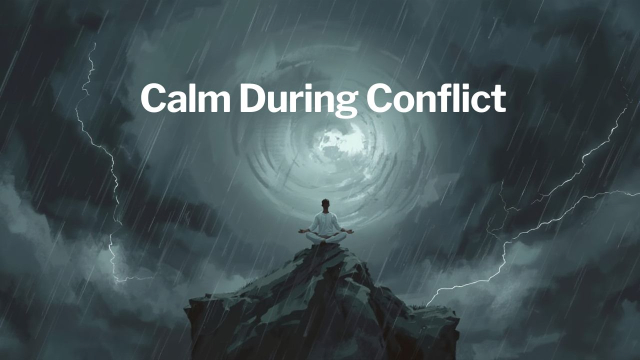
Calm During Conflict
When someone challenges us — even mildly — the brain often interprets it as a threat. Not a physical threat, but a social one. Criticism, disagreement, or perceived disrespect can activate the same stress response that would have once prepared us to fight or flee.
This is why conflict can feel disproportionately powerful.
You may notice:
- A tightening in the chest
- Faster breathing
- Heat in the face
- A strong urge to interrupt or defend
These reactions are automatic. They are not weaknesses. But if you let them take control, they steer the conversation. The goal is not to eliminate emotion. The goal is to regulate it.
Step 1: Slow the Body First
You cannot think clearly while physiologically agitated.
Before trying to “win” the argument or explain yourself, stabilise your body.
A simple technique:
- Inhale slowly for four seconds
- Pause for two
- Exhale for six
Longer exhalations signal safety to the nervous system. Even two or three cycles can reduce the intensity of your stress response.
If possible, sit back slightly. Relax your shoulders. Unclench your jaw. These small physical adjustments often shift your mental state more effectively than trying to reason your way to calm.
Step 2: Delay Your First Reaction
The first thing that comes to mind during conflict is rarely your best response.
It is usually defensive, sharp, or emotionally charged.
Instead of reacting immediately, insert a pause. You can say:
- “Let me think about that for a second.”
- “I want to respond carefully.”
- “That’s interesting — tell me more.”
This buys time. Time reduces emotional intensity. Time prevents regret.
Silence is not weakness. It is control.
Step 3: Separate Tone from Content
During conflict, we often react more to how something is said than to what is said.
If someone sounds critical or irritated, your brain may fixate on the tone and miss the actual issue.
Ask yourself:
“What is the core point they are trying to make?”
Even if their delivery is poor, there may still be useful information underneath. Focusing on content rather than tone keeps the discussion grounded and practical.
Step 4: Shift from Winning to Understanding
Conflict escalates when both parties aim to win.
Calm increases when one person aims to understand.
You do not have to agree. But you can try to accurately summarise the other person’s position:
“So you’re saying you felt overlooked in that decision?”
When people feel understood, their defensiveness drops. And when their defensiveness drops, yours usually follows. Understanding is often more powerful than arguing.
Step 5: Lower the Stakes Internally
One reason conflict feels overwhelming is that we unconsciously raise the stakes.
A disagreement becomes:
“They don’t respect me.”
“This is unfair.”
“This always happens.”
“This threatens our relationship.”
Notice when your mind exaggerates the meaning of the moment. Most conflicts are not existential. They are situational. Reducing the narrative reduces the intensity.
Step 6: Keep Your Voice Steady
Your tone influences the entire emotional temperature of the conversation.
Speak slightly slower than normal.
Lower your volume a fraction.
Avoid sharp emphasis.
Even if the other person becomes louder or more animated, maintaining steadiness often prevents escalation. Calm is contagious — just as agitation is.
Step 7: Know When to Pause the Conversation
Staying calm does not mean staying engaged indefinitely.
If emotions are rising on both sides, it may be wiser to pause:
“I think we’re both getting frustrated. Let’s come back to this later.”
Distance allows emotional processing. Many conflicts resolve more productively after a short break. Choosing to pause is not avoidance. It is strategic regulation.
After the Conflict
Reflection strengthens future calm.
Ask yourself:
- What triggered me most strongly?
- When did I feel my body tense?
- What helped me regain control?
Patterns emerge over time. Awareness reduces reactivity.
You may also notice that conflict often reveals areas of insecurity or fatigue. Sometimes irritability has less to do with the current disagreement and more to do with stress, exhaustion, or accumulated pressure. Understanding this builds long-term emotional resilience.
Calm Is Strength, Not Passivity
Some people equate calmness with weakness. In reality, staying composed during disagreement requires strength. It requires restraint, awareness, and deliberate choice.
Reacting impulsively is easy. Remaining steady is disciplined.
Conflict will always be part of human relationships. But how you handle it determines whether it damages trust or deepens understanding. Calm does not mean silence. It means control. And control gives you influence.