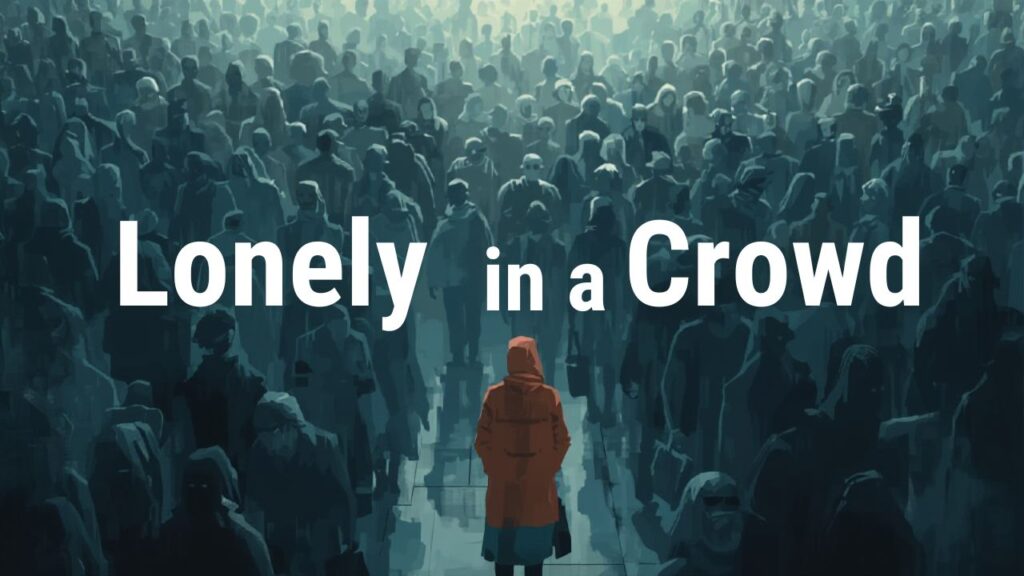
Loneliness is often imagined as an absence. No one to call. No one to sit beside you. No messages lighting up your phone. But for many people, the most confusing and painful kind is feeling lonely in a crowd, busy workplaces, family gatherings, or full social calendars. You can be surrounded by people and still feel profoundly alone.
This experience isn’t a personal failure, and it isn’t rare. It’s a psychological signal. And once you understand what it’s trying to tell you, that loneliness becomes less frightening and more informative.
Lonely in a Crowd
At its core, loneliness isn’t about physical isolation. It’s about emotional disconnection. You can be talking, laughing, and interacting all day while still feeling unseen, unheard, or misunderstood.
Human beings are wired not just for contact, but for connection. We don’t simply need people around us; we need moments where we feel recognised as we really are. When those moments are missing, the brain registers a lack, even if the social environment looks healthy from the outside.
This is why someone can feel lonely in a marriage, in a friendship group, or even in a loving family. The nervous system doesn’t count bodies. It counts attunement.
Surface Interaction vs Emotional Presence
Modern life is full of interaction, but thin on presence. Much of our daily social contact happens on the surface: small talk, polite exchanges, functional conversations, performance-based roles.
We talk about tasks, logistics, news headlines, and shared jokes, but rarely about what’s actually happening inside us. Over time, this creates a strange internal split. You’re socially active, yet emotionally private.
When this becomes a pattern, the brain starts to associate socialising with effort rather than nourishment. You leave conversations feeling oddly emptier than before, unsure why connection doesn’t land the way it used to. Loneliness grows not from lack of people, but from lack of depth.
Wearing a Social Mask
Many people feel lonely because they don’t feel safe being fully themselves. They’ve learned, often unconsciously, that certain parts of them aren’t welcome. So they adapt. They become agreeable, competent, funny, or strong. They keep things light. They don’t rock the boat.
This social masking works in the short term. It helps you belong. But it comes at a cost. When people connect with the carefully managed version of you, the real you remains untouched. Over time, this creates a painful paradox. You’re liked, even valued, but you still feel alone. Because the connection isn’t meeting you.
Loneliness here isn’t about rejection. It’s about self-concealment.
The Loneliness of Not Being Known
One of the deepest human needs is to be known without having to explain yourself constantly. When that need goes unmet, loneliness sets in quietly.
You may feel that no one really understands how you think, what you worry about, or what you’re carrying. Even when others care, there’s a sense that your inner world remains invisible.
This kind of loneliness is especially common in people who are emotionally self-reliant. If you’re the one others lean on, the listener, the problem-solver, the steady presence, you may rarely be asked how you are in a way that invites honesty.
The result is a connection without reciprocity and support without softness.
Digital Proximity, Emotional Distance
Technology has made us more reachable than ever, but reachability isn’t the same as closeness. Messages, likes, and group chats create a sense of constant social presence, yet often lack emotional texture.
Online interaction tends to reward speed, certainty, and presentation. Vulnerability doesn’t travel as easily through screens, and silence is often misinterpreted. This can leave people feeling socially “full” but emotionally underfed.
The brain registers stimulation, but not safety. Contact, but not comfort. Loneliness thrives in this gap.
When Loneliness Is an Identity Signal
Sometimes loneliness isn’t about others at all. It’s about disconnection from yourself. When you’ve been living in survival mode, prioritising productivity, responsibility, or performance, you may lose touch with your own emotional landscape. You keep moving, but something inside you goes quiet.
In these moments, being around people can actually intensify loneliness, because you’re no longer anchored internally. You’re present physically, but not fully inhabiting yourself.
Loneliness here is a signal that something meaningful has been sidelined: creativity, rest, curiosity, or emotional expression. It’s not asking for more people. It’s asking for reconnection.
Why Loneliness Can Feel So Sharp
Loneliness activates the same brain regions as physical pain. From an evolutionary perspective, this makes sense. For early humans, social disconnection meant danger.
So when you feel lonely, your nervous system isn’t being dramatic. It’s responding to a perceived threat: the threat of being emotionally unheld. This is why loneliness can feel heavy, restless, or even shame-tinged. It’s not just sadness. It’s a state of alertness combined with longing.
Understanding this helps remove the self-judgment. Loneliness isn’t weakness. It’s information.
Moving Toward Connection That Nourishes
The antidote to loneliness isn’t more socialising. It’s a more authentic connection.
That starts with small shifts. Letting one conversation go a little deeper. Naming how you actually feel instead of defaulting to “fine.” Spending time with people who allow pauses, nuance, and honesty.
It also means reconnecting with yourself. Noticing what you’re feeling. Giving language to your inner world. Making space for parts of you that haven’t been invited into the room for a while. Loneliness eases when connection becomes less about performance and more about presence.
A Final Thought
Loneliness isn’t a verdict on your life. It’s an invitation to align your relationships, your self-expression, and your emotional needs more closely.
And when that alignment begins, even quietly, connection stops feeling like something you chase and starts feeling like something you recognise.